














































































Design and Functionality of Laboratory Wash Bottles
Alongside other essential liquid-handling tools such as trigger sprayers and dropping bottles, the wash bottles in our product range are engineered for safe, contamination-free, and precise dispensing. They allow controlled delivery of various reagents, with many models featuring standardized hazard labeling compliant with Regulation (EC) No 1272/2008 (GHS).
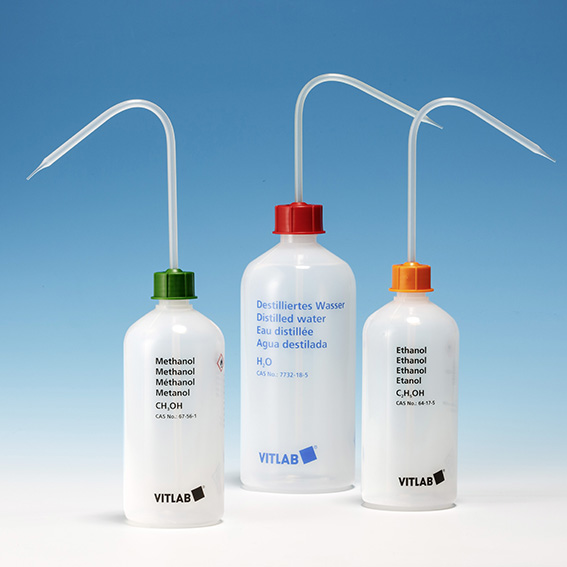
You can choose pre-printed imprints tailored to common laboratory chemicals. Most bottles are molded from flexible low-density polyethylene (LDPE). For applications demanding elevated chemical compatibility or higher thermal limits, polypropylene (PP) models are available.
Key Design Features:
- Cylindrical narrow-neck bottles molded from squeezable, resilient polymer
- Precision-formed, curved dispensing delivery tube (draw tube)
- Integrated Vent-Cap pressure relief valve to eliminate vapor buildup and dripping
- Standard capacities available in 500 ml and 1,000 ml
- Available with chemical-resistant GHS imprints or plain/unprinted
Due to the elastic recovery of LDPE, fluid delivery responds smoothly to manual squeezing. Acids, bases, and rinsing agents can be metered cleanly into petri dishes, volumetric flasks, or narrow reaction vessels. When storing volatile fluids with high vapor pressure, the patented Vent-Cap valve allows internal overpressure to vent safely, preventing spontaneous dripping.
Standard solvent and reagent imprints include:
- Distilled Water
- Acetone (molded in PP)
- Ethanol
- Isopropanol
- Methanol
- Ethyl Acetate
Beyond standard wash dispensing closures, these narrow-neck bottles can be sealed for storage or transport using standard DIN screw caps (such as GL 18, GL 25, or GL 28 threads).
Draw Tube Mechanism and Operating Environments
Wash bottles represent fundamental equipment across chemical synthesis, pharmaceutical manufacturing, biology labs, and industrial testing facilities. The internal draw tube extends flush to the bottom, ensuring a steady, swirl-free dispensing stream upon compression. Please note that these standard industrial wash bottles are delivered non-sterile.
To complement our wash bottle range, we carry a wide assortment of containers, including wide-neck bottles for storing and shipping powders and granulates.