









































































Hydrofluoric acid is nasty stuff. It penetrates tissue and can reach the bone without the victim noticing anything or the skin showing visible damage. When this happened in an episode of the Viennese crime series “Tatort”, people online discussed the dangers of this chemical at length. Contact with an area the size of a palm is usually fatal. Besides its corrosive effect, hydrofluoric acid blocks important enzymes in the body and causes circulatory problems – up to and including cardiac arrhythmia.
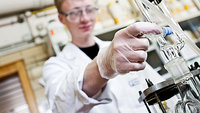
Laboratory technicians are well aware of the dangers of corrosive and toxic substances. They also know the responsibility they carry when they perform animal experiments or modify the gene sequence of organisms. All laboratory work requires strict compliance with hygiene and safety regulations. Protective clothing, gloves and safety goggles are mandatory, especially because of the hazardous substances involved.
Here we present the top ten laboratory professions and tell you in which jobs things smell and smoke and where they can get really dangerous. Our “lab meter” shows what percentage of the work takes place in the laboratory. We also list the skills that matter if you are planning a career in the lab.
Agricultural technical assistant
Agricultural technical assistants are laboratory specialists who also spend a large part of their working time outside the lab. The job mainly takes place outdoors, but in research it can also involve a wide range of laboratory work. In some German federal states, the profession is still called “Landwirtschaftlich-technischer Assistent”.
What does the work typically involve?
- Breeding plant species
- Quality testing of animal feed or food
- Mineral analysis of soils
- Fertiliser analysis
- Water sampling
Where can you work?
Besides agriculture, you can work in biotechnology, animal and plant breeding, the dairy and meat industry, the environmental sector or the food industry. Agricultural technical assistants most often work in forestry and agricultural businesses, in public administration or in chemical and pharmaceutical companies, and in some cases in research.
What are the entry requirements?
The training requires an intermediate school-leaving certificate (Mittlere Reife). Vocational schools select their applicants themselves. In-depth knowledge of biology, chemistry and physics is an advantage. Basic maths skills are also required, especially statistics and percentage calculation. English and IT skills are useful as well.
What salary can you expect?
Training at the vocational school is unpaid. According to the Entgeltatlas of the German Federal Employment Agency, full-time employees in this field usually earn between 3,410 and 4,750 euros gross per month (median: around 4,030 euros), depending on the focus of the training and work experience.
Are there further training opportunities?
In most cases you can deepen your specialisation through further training. These courses are subject to a fee but eligible for funding, and employers often contribute. Another option is further training as a technician, for example a laboratory or environmental technician, which sometimes comes with first management responsibilities. With the right qualifications, you can also go on to study biotechnology, agricultural science or agricultural biology.
|
Training |
Duration |
Lab share |
Skills |
Special features |
|
School-based training |
2 years |
25 – 50 % |
|
Opportunity to work with animals |
Pharmaceutical technical assistant
Most pharmaceutical technical assistants (PTA) work in a public pharmacy, where they take on the responsible task of customer care. They advise customers and patients on the correct use of medical products.
What does the work typically involve?
- Preparing ointments and solutions under supervision
- Testing substances according to the pharmacopoeia
- Chemical and physical drug analyses
- Customer advice, sales, inventory and stock control
Where can you work?
Most PTAs work in public pharmacies, hospital pharmacies or mail-order pharmacies. PTAs also support research teams in the laboratories of universities and colleges with experiments and test series.
What are the entry requirements?
The training requires an intermediate school-leaving certificate (Mittlere Reife). Vocational schools select their applicants themselves. Anyone who wants to work in a pharmacy should have strong communication skills and a customer focus. Besides knowledge of chemistry, physics and maths, basic Latin is helpful because of the pharmaceutical terminology.
What salary can you expect?
In public pharmacies, pay is often based on a collective agreement. Besides the nationwide pay agreement, the chamber districts of Nordrhein and Saxony have their own pay scales. Since January 2026, the nationwide pay scale has ranged from 2,646 euros (1st–2nd year in the job) to 3,267 euros (from the 15th year) gross per month. During the six-month practical training in a pharmacy, PTA trainees receive 876 euros per month under the agreement.
Are there further training opportunities?
Further training is offered by the further-education institute for PTAs (WIpta). Its qualifications are recognised nationwide as IHK (chamber of commerce) qualifications and can focus on specific sectors or directions, such as business administration, hospitals, industry, nutrition or naturopathy.
|
Training |
Duration |
Lab share |
Skills |
Special features |
|
School-based training |
2.5 years |
10 – 25 % |
|
Direct contact with customers |
Physics technical assistant
As a physics technical assistant, you support physicists in their scientific work and in the further development of physical processes. The main fields are measurement, control, electrical and tooling technology. Working conditions sometimes include extreme environments such as high air pressure or high temperatures.
What does the work typically involve?
- Setting up experimental rigs
- Developing prototypes and equipment
- Preparing, documenting and evaluating series of measurements
- Testing material properties
Where can you work?
Most assistants work in research institutions of universities and colleges or in the development departments of companies. Industries range from construction and mechanical engineering to the chemical industry and nanotechnology. In some cases, unrelated sectors such as medicine and environmental protection are also an option.
What are the entry requirements?
The training requires an intermediate school-leaving certificate (Mittlere Reife). Vocational schools select their applicants themselves. A good understanding of maths and physics is required, along with knowledge of electrical engineering and computer science.
What salary can you expect?
Pay depends on work experience, company size and above all on the scope of the role. According to the Entgeltatlas of the German Federal Employment Agency, the median in this field is around 4,870 euros gross per month. Depending on qualifications and experience, pay can be considerably higher: a quarter of full-time employees earn more than around 5,960 euros gross per month.
Are there further training opportunities?
Specialist further training lets you deepen areas such as physical measurement technology, radiation protection, laser technology, quality testing or occupational safety. The main career-advancement route is the state-certified technician, for example in environmental, materials or mechanical engineering. With the right qualifications, you can also go on to study physics, engineering physics or related subjects.
|
Training |
Duration |
Lab share |
Skills |
Special features |
|
School-based training |
2 – 3 years |
50 – 75 % |
|
Sometimes demanding working conditions |
Physics laboratory technician
Physics laboratory technicians determine the properties of materials through tests and experiments. They use computer-based measuring systems and document, analyse and evaluate their results. They work closely with physicists and engineers.
What does the work typically involve?
- Machining materials and building materials (turning, milling etc.)
- Working with glass and ceramics
- Carrying out technical test series
- Servicing and maintaining equipment
Where can you work?
Typical workplaces are university institutions such as physics research institutes, as well as testing laboratories. They serve various industries, for example mechanical engineering, the glass industry and the building materials industry. The work very often takes place in the lab, but also in offices and workshops.
What are the entry requirements?
There are no legal requirements. Most companies hire apprentices with a university entrance qualification (Abitur) or an intermediate school-leaving certificate. Good knowledge of electrical engineering, computer science, optics, mechanics, heat engineering and possibly photography is expected by the start of the career at the latest.
What salary can you expect?
In the chemical industry, apprentice physics laboratory technicians earn 1,147 to 1,204 euros in the first and 1,329 to 1,486 euros in the fourth year of training, depending on the pay region; in the public sector of the federal states, they earn 1,297 euros in the first and 1,470 euros in the fourth year. According to the Entgeltatlas of the German Federal Employment Agency, the median salary in this field is around 4,870 euros gross per month; a quarter of full-time employees earn less than around 3,990 euros. Depending on the scope of the role, experience and company size, it can rise to over 5,900 euros gross per month.
Are there further training opportunities?
There are several technician training routes: you can train as a physics technician or choose a different focus, for example as an electrical engineering technician or mechatronics technician. With a university entrance qualification, you can also go on to a bachelor’s and then a master’s degree, for example in physics.
|
Training |
Duration |
Lab share |
Skills |
Special features |
|
Dual vocational training |
3.5 years |
75 – 100 % |
|
Sometimes demanding working conditions |
Biology laboratory technician
Biology laboratory technicians study organisms such as animals and plants, as well as microorganisms and cell cultures. They handle chemicals and active substances, prepare and carry out experiments and evaluate them. They also look after and maintain the laboratory equipment.
What does the work typically involve?
- Breeding and analysing parasites and pests
- Assisting with animal experiments (administering drugs, taking samples)
- Investigating drug side effects
- Developing and analysing plant protection products
- Experiments involving genetic engineering
Where can you work?
Most biology laboratory technicians work in medical and biological research, applied medicine, the pharmaceutical, food or cosmetics industry, or in hospitals.
What are the entry requirements?
There are no legal requirements, but most companies expect a university entrance qualification (Abitur). In-depth knowledge of biology, chemistry, physics and maths is an advantage. You should also have good English, be comfortable learning professional software and enjoy working in a team.
What salary can you expect?
In the chemical industry, apprentices earn between 1,147 and 1,204 euros in the first and between 1,329 and 1,486 euros in the final year of training, depending on the pay region. According to the Entgeltatlas of the German Federal Employment Agency, the median salary of full-time employees under 25 in this field is around 3,630 euros gross per month, and around 4,290 euros across all age groups, depending on specialisation and field of work. Further training opens up additional career steps.
Are there further training opportunities?
As a technician in biotechnology, chemical engineering or environmental engineering, you can specialise in a particular field. This training takes two years at a technical school. Training as a certified technical business administrator (Technischer Fachwirt) can also be combined with a master craftsman exam and funded through Germany’s Aufstiegs-BAföG. Academic options include human biology or molecular biology degrees.
|
Training |
Duration |
Lab share |
Skills |
Special features |
|
Dual vocational training |
3.5 years |
75 – 100 % |
|
Protective equipment mandatory, risk of allergies |
Chemistry laboratory technician
Chemistry laboratory technicians are the all-rounders of the lab. They analyse raw materials, intermediate and end products for their chemical composition, test inorganic and organic products and investigate chemical processes. They usually work in teams with chemists or engineers.
What does the work typically involve?
- Quality measurements on products (pH value, viscosity etc.)
- Developing prototypes in cosmetics
- Computer-based evaluation of test data
- Sampling and breaking down substances
- Preparing chemical solutions
Where can you work?
Most chemistry laboratory technicians work in the chemical and pharmaceutical industry. They are also employed in the paint and coatings industry and in the food and cosmetics industry. Other employers include scientific and medical institutes at universities, chemical testing and consulting firms, and environmental agencies.
What are the entry requirements?
There are no legal requirements, but most companies expect a university entrance qualification (Abitur) or at least an intermediate school-leaving certificate. In-depth knowledge of biology, chemistry, physics and maths is welcome. English is required in research. Since most analyses run on computer-based systems, good knowledge of the relevant software is essential.
What salary can you expect?
In the chemical industry, apprentices earn between 1,147 and 1,204 euros in the first and between 1,329 and 1,486 euros in the final year of training, depending on the pay region. In companies bound by the chemical and pharmaceutical industry’s collective agreement, the starting salary is between 3,500 and 3,700 euros gross per month depending on the pay region, slightly below that of a chemical engineering technician or a certified industrial foreman in chemistry. In the chemical industry, pay follows the chemical industry’s collective agreement; in the public sector, it follows the pay groups and levels of the collective agreement for the federal states.
Are there further training opportunities?
As a laboratory technician, you can later train chemistry apprentices yourself, although the IHK course is not offered in every federal state. The state-certified technician in chemical engineering is another route: this part-time training takes four years and qualifies you both to train others and to lead a team. Possible degree courses include chemistry, process engineering, environmental engineering or food technology.
|
Training |
Duration |
Lab share |
Skills |
Special features |
|
Dual vocational training |
3.5 years |
75 – 100 % |
|
Protective equipment mandatory |
Veterinary technical assistant
Veterinary technical assistants (VTA) examine substances of animal origin, such as medicines, cosmetics, meat and milk, as well as animal tissue and body fluids. Their tests do not focus only on pathogens but on all histological, microscopic, biological, immunological, physical, chemical and biochemical abnormalities. Since 2023, the official job title in Germany has been “Medizinische/r Technologe/Technologin für Veterinärmedizin” (medical technologist for veterinary medicine).
What does the work typically involve?
- Determining defined values in test series
- Preparing and examining specimens and cultures
- Working with vaccines and analysing allergens
- Testing organic and inorganic compounds for residues
- Analysing blood samples
Where can you work?
VTAs work in laboratories, veterinary clinics and practices, and in the state testing agencies of the German federal states. They are also employed in pharmaceutical laboratories, medical research and the food industry. VTAs carry particular responsibility in the control laboratories of slaughterhouses and dairies.
What are the entry requirements?
The training requires an intermediate school-leaving certificate (Mittlere Reife). Vocational schools select their applicants themselves. Above all, you should bring technical understanding and knowledge of chemistry, biology and maths.
What salary can you expect?
Since the 2023 reform, trainees receive a training allowance, for example 1,341 euros in the first, 1,401 euros in the second and 1,498 euros in the third year of training in the public sector of the federal states. According to the Entgeltatlas of the German Federal Employment Agency, full-time employees in this field usually earn between 3,310 and 4,840 euros gross per month (median: around 4,140 euros). Pay also varies with experience, field of work and location.
Are there further training opportunities?
In some cases you can deepen your specialisation through further training. These courses are subject to a fee but partly eligible for funding, and employers often contribute. VTAs can train as biomedical specialist analysts for histology. With the right qualifications, you can also study biology or veterinary medicine after your first years in the job.
|
Training |
Duration |
Lab share |
Skills |
Special features |
|
School-based training |
3 years |
50 – 75 % |
|
Frequent contact with germs, so protective equipment is required |
Paint and coatings laboratory technician
Paint and coatings laboratory technicians examine coating materials, above all paints and varnishes. They plan and carry out test series. Often the aim is to improve paints and other coatings for different substrates such as wood or metal. They assess the condition of surfaces and test the durability of coatings.
What does the work typically involve?
- Product development and regulatory compliance (VOC Directive etc.)
- Shading colour batches in production
- Pre-treating and coating substrates
- Producing coatings with special functions
Where can you work?
As a paint and coatings laboratory technician, you mainly work in the chemical industry, especially the paint and coatings industry. There are also positions in research, for example at the Fraunhofer Society.
What are the entry requirements?
No specific qualification is required for the training. However, applicants with a university entrance qualification (Abitur) or an intermediate school-leaving certificate are preferred. You should be interested above all in chemistry, biology and physics. In-depth maths skills are also expected.
What salary can you expect?
In the chemical industry, apprentice pay is between 1,147 and 1,204 euros in the first and between 1,329 and 1,486 euros in the final year, depending on the pay region. In chemical companies bound by the collective agreement, the starting salary is between 3,500 and 3,700 euros gross per month; according to the Entgeltatlas of the German Federal Employment Agency, the median salary in this field is around 4,850 euros. These figures depend on the federal state and company size.
Are there further training opportunities?
Further training options include the certified industrial foreman and the paint and coatings technician. The technician course takes two years and offers various specialisations, which can, for example, also lead to self-employment in the construction industry. With a university entrance qualification, you can also study chemical engineering specialising in paints and coatings.
|
Training |
Duration |
Lab share |
Skills |
Special features |
|
Dual vocational training |
3.5 years |
50 – 75 % |
|
Exposure to toxic fumes |
Biological technical assistant
The biological technical assistant (BTA) supports scientists in carrying out and documenting experiments and tests in the laboratory. The subjects of study are animals, plants, cell cultures and microorganisms. Fields of work include not only biochemistry, microbiology and botany but also zoology and medicine.
What does the work typically involve?
- Taking and preparing samples
- Setting up and running experiments
- Food control in accordance with legal regulations
- Documenting test series
Where can you work?
BTAs are mainly needed in research, i.e. in scientific institutions in the natural sciences, medicine or environmental research. They are also part of the core workforce in the chemical and pharmaceutical industry, and they work in public administration, especially in testing laboratories.
What are the entry requirements?
An intermediate school-leaving certificate (Mittlere Reife) is required. A medical certificate of fitness may be needed before the training starts. Vocational schools are free to decide on their selection criteria. Biology, chemistry, physics, maths and English are the subjects of choice.
What salary can you expect?
In many cases, pay is bound to a collective agreement. Under the collective agreement for the public sector of the German federal states (TV-L), the starting salary has ranged from 3,074 euros (E5, level 1) to 3,420 euros (E8, level 1) gross per month since April 2026. Starting salaries in the private sector are somewhat higher, depending on the responsibilities involved.
Are there further training opportunities?
Since most BTAs hold a university entrance qualification, degree courses in biology, chemistry, biochemistry, forestry or microbiology are a natural next step. With the right qualifications, studying medicine is also possible.
|
Training |
Duration |
Lab share |
Skills |
Special features |
|
School-based training |
2 – 4 years |
50 – 75 % |
|
Opportunity to contribute to basic research |
Chemical technical assistant
As a chemical technical assistant (CTA), you are responsible for preparing and carrying out chemical analyses and test series. In the preparation phase you select chemicals and equipment, then set up apparatus and measuring instruments, and in the documentation phase you record all results on the computer. Research and development often involves several test series. CTAs also support the launch of new products into production.
What does the work typically involve?
- Preparing mixtures of substances
- Carrying out synthesis processes
- Setting up and running experiments
- Food control in accordance with legal regulations
- Documenting test series
Where can you work?
CTAs are often employed in research and development at universities. They also take on important tasks in companies, for example in food and environmental analysis. Most employers are in the pharmaceutical or chemical industry, some in the plastics industry. Other fields include the food industry and hazardous waste disposal.
What are the entry requirements?
An intermediate school-leaving certificate (Mittlere Reife) is required. Vocational schools decide on the allocation of training places themselves. You should be comfortable with biology, chemistry, physics, maths, English and computer science.
What salary can you expect?
No salary is paid during the school-based training. As a guideline, the starting salary corresponds at least to pay group E8 of the collective agreement for the German federal states, i.e. about 3,420 euros gross per month (level 1) since April 2026. Over the years you can rise to pay group E10 (from around 4,040 euros), plus increments for years of service. Salaries in the private sector are similar.
Are there further training opportunities?
CTAs can also train as technicians in chemical engineering. The certified industrial foreman is another option and can be funded through Germany’s Aufstiegs-BAföG. Courses range from technical specialisation and IT training to quality assurance and occupational safety. With a university entrance qualification, you can also study chemistry or food chemistry.
|
Training |
Duration |
Lab share |
Skills |
Special features |
|
School-based training |
2 – 4 years |
50 – 75 % |
|
Working with corrosive substances |
Sources (as of October 2026)
Salary figures are guide values and vary by region, employer and whether a collective agreement applies.
- BERUFENET: Agrarwirtschaftlich-technische/r Assistent/in
- BERUFENET: Pharmazeutisch-technische/r Assistent/in
- BERUFENET: Physikalisch-technische/r Assistent/in
- BERUFENET: Physiklaborant/in
- BERUFENET: Biologielaborant/in
- BERUFENET: Chemielaborant/in
- BERUFENET: Medizinische/r Technologe/Technologin – Veterinärmedizin
- BERUFENET: Lacklaborant/in
- BERUFENET: Biologisch-technische/r Assistent/in
- BERUFENET: Chemisch-technische/r Assistent/in
- Entgeltatlas der Bundesagentur für Arbeit (Stichtag 31.12.2025)
- Bundesagentur für Arbeit: Entgelte der Vollzeitbeschäftigten im Jahr 2025 (Presseinfo vom 20.07.2026)
- TdL: TV-L Entgelttabelle (Anlage B), gültig ab 01.04.2026
- ADEXA/ADA: Gehaltstarifvertrag für Apothekenmitarbeiter, gültig ab 01.01.2026
- DAS PTA MAGAZIN: PTA Gehalt – Tarife Bundesgebiet, Nordrhein und Sachsen
- PTA-Berufsgesetz (PTAG), § 11 Dauer und Struktur der Ausbildung
- Chemie-Sozialpartner (elementare-vielfalt.de): Gehalt in Ausbildung und Beruf
- IGBCE: Tarifabschluss Chemie 2026
- Aufstiegs-BAföG (Bundesministerium)
Note: This article was originally published in 2015 and was revised and updated with the help of AI in October 2026. All information is provided without guarantee.