




























































TLDR: This technical comparison evaluates glass and plastic containers for water sampling across sterilization efficiency, operational expenditure, and life cycle environmental impact. While reusable borosilicate glass allows thermal autoclaving and depyrogenation, it requires labor- and energy-intensive reprocessing with persistent cross-contamination risks. Pre-sterilized single-use plastic containers (e-beam irradiated to ISO 11137) offer immediate operational readiness, integrated batch traceability, and substantial labor savings. A total cost analysis demonstrates that single-use polymer bottles frequently achieve higher overall cost efficiency when energy and staff labor are accounted for.
Sterilization and Sample Integrity
The primary mandate of any accredited water testing laboratory is ensuring absolute sample integrity. A decisive parameter is the verified sterilization of sampling containers to eliminate microbial contaminants that could falsify analytical assays. Both laboratory-grade glass and technical polymers possess material-specific advantages and operational trade-offs regarding thermal resilience, handling complexity, and validation compliance.
Sterilization Efficiency and Methods
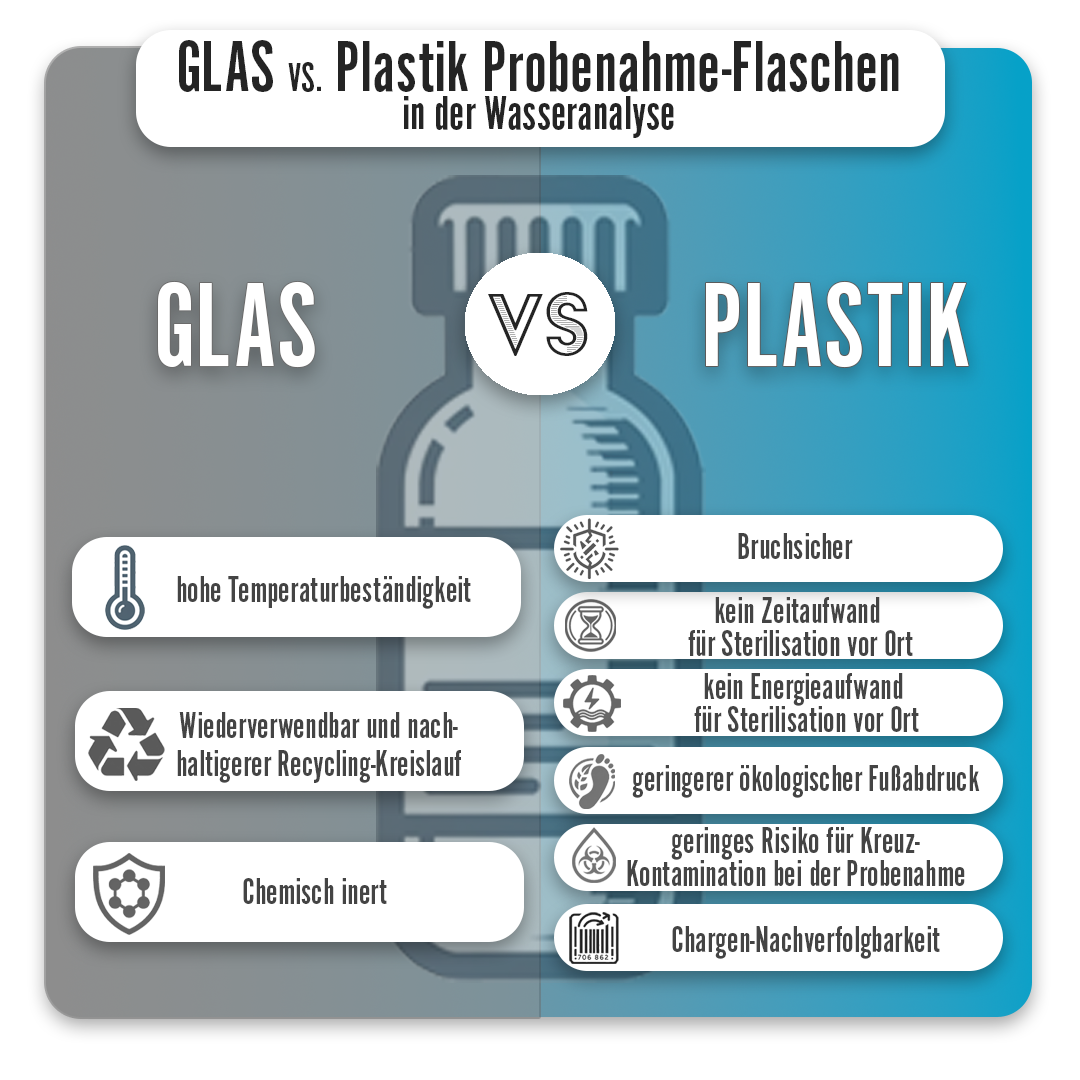
Glass vessels can be reprocessed using dry-heat sterilization (e.g., 160 °C for 2 to 3 hours) or moist heat inside autoclaves. Laboratory borosilicate glass withstands thermal peaks up to 500 °C without structural degradation. A distinct material asset of glass is its capability for complete depyrogenation, destroying bacterial endotoxins alongside viable microbes. However, cycle runtimes are extensive. Furthermore, in-house reprocessing carries inherent risks of cross-contamination from chemical detergent residues or persistent mineral scaling if cleaning protocols are not rigorously controlled.[1][2][3]
Conversely, industrially pre-packaged plastic containers – such as those provided by aqua Laborservice – offer distinct process advantages. Sterilization via electron beam (e-beam) radiation occurs directly within final bulk packaging. Washing, rinsing, and drying cycles are entirely eliminated, preventing cross-contamination at the source. Ready-to-use straight from the carton, these containers save measurable labor and utility energy. Molded calibrations, printed barcodes, and batch tracking numbers support seamless integration into laboratory information management systems (LIMS). Sterilization validated to ISO 11137 secures a Sterility Assurance Level (SAL) of 10-6, while integrated tamper-evident screw closures preserve interior sterility until sampling occurs.[4][5][6]
Total Cost of Ownership Analysis
In a standardized comparative model (see Appendix), annual operating expenses of €10,878.50 for reusable glass bottles (250 ml and 500 ml with GL45 caps) were contrasted with €10,500.00 for pre-sterilized polypropylene wide-mouth bottles from aqua Laborservice. The calculation demonstrates that disposable polymer containers do not inherently result in higher operational spending. The decisive factors are not unit procurement rates, but indirect overhead: autoclave capital depreciation, utility draw, deionized rinse water, and, predominantly, dedicated staff labor for preparation, cycle loading, and post-processing inspection. Under standard operational conditions, disposable polymers routinely reduce total processing expenditure.
Carbon Footprint and Environmental Impact
Evaluating environmental compatibility requires a comprehensive cradle-to-grave life cycle perspective. Glass carries an elevated carbon footprint during manufacturing and freight transit due to high raw material weight and intense melting energy. Ongoing on-site thermal sterilization cycles compound cumulative energy consumption. While regular multi-cycle re-use mitigates upfront embodied emissions over time, heavy glass transit demands protective packaging to prevent transit breakage, generating ancillary packaging waste.[7][8][9][10][11][12]
Pre-sterilized polymer containers minimize transit weight and eliminate localized high-draw autoclave cycles. However, single-use models generate post-sampling solid waste. Pure mono-materials like HDPE, PP, and PET-G exhibit lower cumulative life cycle energy requirements than short-cycle glass fleets, provided spent containers are channeled into dedicated mechanical recovery streams.[13][14]
Polymer Recycling and Material Streams
While glass is chemically inert and infinitely remeltable, engineering plastics provide decisive physical benefits including shatter resistance, elastic sealing capability, and substantial tare weight reduction. In Germany, mechanical recovery for commercial plastic packaging reached 48.8% in 2019. High-volume mechanical reprocessing infrastructure exists predominantly for sorted HDPE and PET, with polypropylene regranulates seeing expanding demand in technical markets.[15][16][17][18]
Standard polyethylene (PE) and polypropylene (PP) sampling vessels are readily recyclable via mechanical granulation if segregated cleanly from chemical contaminants. Conversely, glycol-modified PET (PET-G) cannot be co-processed within standard PET bottle streams due to divergent melting points and crystallization kinetics, requiring segregated collection to prevent operational disruptions during thermal extrusion.[19][20]
Regulatory Compliance in Germany
Laboratory waste management in Germany is governed by the European Waste Catalogue ordinance (Abfallverzeichnis-Verordnung – AVV). Containers exposed to hazardous chemicals or toxic industrial effluents must be classified as hazardous waste and disposed of via certified hazardous materials contractors. Bottles containing non-hazardous water matrices fall under the Circular Economy Act (Kreislaufwirtschaftsgesetz – KrWG), mandating material-level recovery where technically feasible.[21][22][23]
Used sampling containers from professional laboratories do not qualify as commercial municipal sales packaging and are legally excluded from dual collection systems (Gelbe Tonne). Disposal must be contracted through certified commercial waste management operators who shred, wash, and convert segregated non-hazardous polymer fractions into technical secondary regranulates.[24][25][26][27][28][29][30]
Operational Selection Criteria
Container selection ultimately hinges on specific analytical testing matrices. Borosilicate glass remains strictly mandatory for trace testing of volatile organic compounds (VOCs) or aggressive organic solvents prone to leaching additives or diffusing through polymer walls. For standard microbiological diagnostics, field sampling, and high-throughput water monitoring, pre-sterilized single-use plastic bottles deliver superior operational ergonomics, occupational safety, and cost efficiency.
Appendix: Comparative Cost Calculation Model
Baseline parameters: A water testing laboratory processes 20 bottles of 250 ml and 20 bottles of 500 ml daily across 250 annual operating days (10,000 total samplings per year).
- Reusable Borosilicate Glass (On-site Autoclaving):
- Autoclave capital depreciation (€5,000 over 10-year term): €500.00/year
- Energy consumption (2 cycles/day at 1 kWh at €0.30/kWh): €150.00/year
- Water and wastewater utilities: €2.50/year
- System maintenance and certification (2% p.a.): €100.00/year
- Storage and racking floor space allocation: €100.00/year
- Labor allocation (0.5 h per cycle at €30.00 hourly gross rate): €7,500.00/year
- Initial fleet, replacement at 1% breakage, and standard 40-cycle retirement: €2,626.00/year
- Total Annual Glass Reprocessing Cost: approx. €10,878.50/year
- Pre-Sterilized Single-Use Plastic System (aqua Laborservice):
- Procurement (5,000 units 250 ml at €0.78 + 5,000 units 500 ml at €1.07): €9,250.00/year
- Certified commercial disposal (€0.10/unit): €1,000.00/year
- Pallet warehousing storage allocation: €250.00/year
- Total Annual Single-Use Plastic Cost: €10,500.00/year
[1] DWK Life Sciences: Sterilisation of Glass Containers | [2] Adinath: Sterilization of Glass Containers in Pharmaceuticals | [3] MedicalExpo: Sterilization Technology Overview | [4] PubMed: E-Beam Sterilization Studies | [5] DWK Life Sciences: Sterilisation of Plastic Bottles | [6] BioPharm International: Glass or Plastic Container Choices | [7] Environment Journal: Environmental Assessment of Glass vs Plastic | [8] Going Zero Waste: Life Cycle Considerations | [9] European Commission: Packaging LCA Study | [10] Incap: Sustainability Impact of Container Materials | [11] Cary Company: Glass vs Plastic Packaging | [12] Earth.org: Environmental Impact of Glass | [13] MDPI Sustainability: Single-Use Laboratory Plastics | [14] Packaging Digest: Material Comparison | [15] Umweltbundesamt: Verwertungsquoten | [16] Umweltbundesamt: Kunststoffe | [17] Waste Management: Polymer Recycling Streams | [18] Recycling Today: European HDPE/PP Recycling Capacities | [19] EMBO Reports: Laboratory Plastic Footprint | [20] Springer: PET vs PET-G Recycling Compatibility | [21] BMUV: Abfallverzeichnis-Verordnung | [22] Gesetze im Internet: Kreislaufwirtschaftsgesetz | [23] BMUV: Abfallnachweisverfahren | [24] Duale Systeme Information | [25] Veolia: Kunststoffabfälle im Labor | [26] REMONDIS: Laborabfälle Entsorgung | [27] Nehlsen: Kunststoffrecycling | [28] Wir-entsorgen: Gewerblicher Kunststoff | [29] Umweltbundesamt: Verwertung von Kunststoffabfällen | [30] Entsorgergemeinschaft der Deutschen Entsorgungswirtschaft | [31] Fisher Scientific: Fisherbrand Laborflaschen | [32] aqua Laborservice | [33] aqua Laborservice: Abfüllflaschen Wasserprobenahme | [34] Diehl Metering: Wasserverbrauch | [35] Deutschland.de: Arbeitsentgelte | [36] Indeed: Gehaltsdaten Labortechniker