



























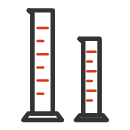

























A graduated cylinder is a tall, vertical vessel featuring a pouring spout, a stable base, and a calibrated scale designed for precise liquid volume measurement. They are manufactured in both tall and low-form designs, conforming to the framework standards of DIN EN ISO 4788 (Laboratory glassware – Graduated measuring cylinders and mixing cylinders).


Graduated cylinders are fabricated from either borosilicate glass or high-performance polymers (PP, PFA, or PMP). Common capacities range from 10 ml up to 2 liters. As total volume increases, the scale division intervals broaden accordingly, representing the smallest readable volumetric unit.
Accuracy and Tolerances
Because their vertical profile is significantly narrower than that of measuring beakers, graduated cylinders provide considerably higher measurement precision.
International standards define two distinct accuracy classes:
- Class A: Represents tight error tolerances according to DIN EN ISO. Class A volumetric instruments are predominantly produced from glass or crystal-clear polymethylpentene (PMP).
- Class B: Typically permits error limits double those of Class A. In this classification, cylinders fabricated from chemical-resistant polypropylene (PP) are widely utilized.
Plastic graduated cylinders typically feature raised-relief or molded graduations. This design ensures markings remain legible and tactile during daily washing cycles, even if printed ink markings eventually degrade.
Operating and Reading Graduated Cylinders
As a rule, measuring cylinders are calibrated to contain (“IN”), indicated clearly near the rim above the graduation marks. Calibration to “IN” means the volume indicated by the liquid corresponds to the exact quantity held within the cylinder. Conversely, calibration to deliver (“EX”) is customary for pipettes, where the delivered outflow corresponds to the nominal marking.
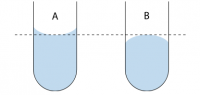
Accurate measurement requires precise alignment with the meniscus – the curve formed by the liquid surface against the cylinder wall.

Depending on liquid properties, two distinct surface curves can form:
- Concave Meniscus (curving downward, e.g., water, figure A): Alignment is established by matching the lowest point of the curve precisely with the graduation line.
- Convex Meniscus (curving upward, e.g., mercury, figure B): The apex (highest point) of the liquid dome must align flush with the graduation mark.
To eliminate parallax error – which introduces substantial reading inaccuracies – observation must be conducted strictly at eye level with the calibration mark.