












































































Over the last few decades, environmental and climate protection has become an omnipresent term, almost a motto. Companies and products advertise with eco-friendly slogans and increasingly provide various certificates intended to show how important environmental protection is to them. Today it is no longer just corporations and businesses that are directly affected by these questions: consumers, too, are reminded of environmental protection in almost every part of daily life. Google, for example, suggests “How can I help protect the environment?” as the first query on the topic. The media and science constantly deliver new articles and findings on how and where the environment can and must be protected.
 So it is hardly surprising that environmental protection quickly polarises opinion. Many industries are quickly condemned by the public as polluters. Many consumers, for example, see the packaging industry purely as a producer of waste at the expense of the environment. The recently introduced EU ban on single-use plastic products [1] has put the disadvantages of plastic back in the spotlight. Plastic's positive properties, namely hardness and resilience, dimensional and heat stability, and durability, are interpreted as drawbacks here. Of course, it is a fact that even today, despite the ban, far too much packaging waste is produced, which practically encourages consumers to pollute the environment. The debate about microplastics [2] in the world's oceans deserves mention here, as does the worrying amount of waste per capita [3] generated worldwide every year.
However, we have to ask whether doing without plastic altogether is automatically better for the environment.
Plastic versus wood, metal & glass
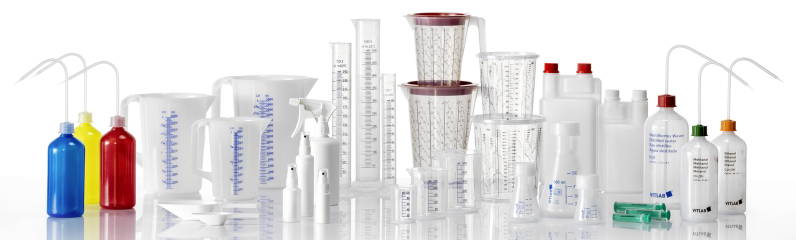
 The properties of plastics mentioned above are, of course, also their advantages. In some cases it is more environmentally friendly and even healthier to transport certain products in safe plastic containers. First of all, the right plastic containers ensure that the product reaches its destination as safely and tightly sealed as in a glass bottle.
A plastic container that suits the medium can also guarantee that sensitive products are not altered by interactions with the container. Depending on the substance, even glass containers are not always the right choice here. One example is our UN dangerous goods bottles.
 A plastic container can also be freely shaped and even coloured, so it can be adapted to the respective product. A good example is our range of stackable storage boxes . Many plastic transport solutions are also reusable and can be washed without leaving residues, like the drinks crate from the local supermarket. Comparing a plastic box with a traditional wooden or metal crate quickly shows that it is more weather-resistant, more durable and at the same time lighter. The weight saved therefore also improves the ecological footprint [4] , as the products only have to be manufactured once and can be transported more efficiently. The vehicles themselves are also becoming lighter thanks to the extensive use of plastics, which helps reduce fuel consumption.
High-tech plastics
Development in plastics production and disposal is not standing still either. Revolutionary concepts keep emerging with different aims. There are already plastics made from renewable raw materials [5] that are also combustible without residue [6]. Special films that actively interact with their environment have also been developed. They keep fruit and meat fresh for longer [7]. Companies increasingly see it as their responsibility to minimise waste from the plastics industry. After all, even though it is consumers who buy packaging and eventually dispose of it, it is the producers who encourage this mindset with cheap single-use packaging.
This blog article is of course not intended to be a comprehensive work on plastics. I simply wanted to encourage you to take a closer look at the topic. If I have sparked your interest, feel free to follow the links to further articles.
Further information and sources (in German):
[1] German Environment Agency: EU ban on single-use plastic products
[2] BUND: Microplastics in the oceans and report on microplastics in cosmetics
[3] German Environment Agency: Packaging consumption in Germany
[4] Ecological Footprint platform
[5] Handelsblatt: Compostable plastics from the field
[6] VVK bioplastics: Advantages and thermal recovery
[7] Planet Wissen: Plastic as a material
Image sources:
© Stephan Glinka / BUND: Microplastics from cosmetic products on a finger (BUND background report)
© Antoine GIRET: Mountain of rubbish and garbage on the beach by the sea (Unsplash reference)